How to Research a Company Before Your Interview (Without Wasting Time)
Most candidates skim the “About Us” page and call it research. That is not research. That is reading a brochure.
In 2026, hiring is different. That means your resume gets screened by software before a human reads it, and your interview answers get compared against a structured scoring model. The candidates who stand out are the ones who walk in knowing things the job description never told them.
This guide gives you a system. Not a checklist of obvious steps, but a practical, time-efficient method to understand a company before you sit down with them.

Why Company Research Actually Matters in 2026
A 2024 survey found that 70% of hiring managers expect candidates to know recent developments about the company, such as a new product launch or a recent merger. Most candidates do not meet that bar.
Research does three things for you:
It sharpens your answers. When you know the company’s current priorities, you stop giving generic responses. You start connecting your experience directly to their problems.
It builds real confidence. Anxiety comes from uncertainty. When you know who you are talking to, what they care about, and what they are trying to solve, the interview feels like a conversation rather than an interrogation.
It helps you make a better decision. You are not just trying to get the job. You are deciding whether to spend the next few years of your life there.
Step 1: Start With the Company Website, but Go Deeper Than the Homepage
The website shows you how the company wants to be seen. That is useful, but limited.
Read the mission statement carefully. Pay attention to the exact language. Companies that say “we move fast” operate very differently from companies that say “we build lasting partnerships.” These words are signals about culture, pace, and priorities.
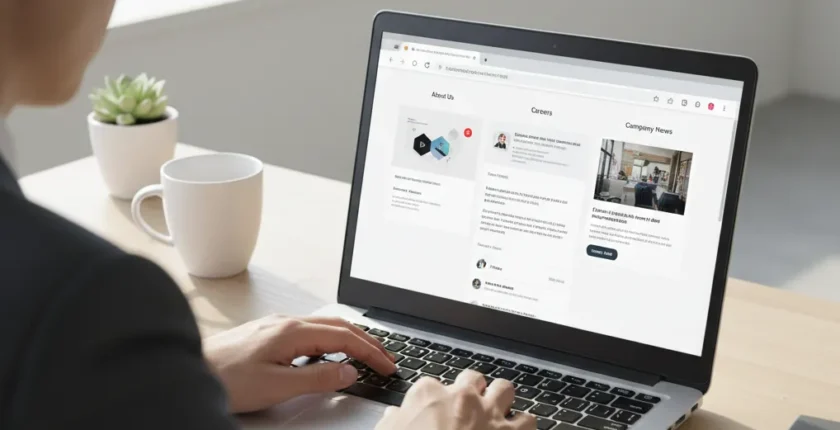
Check the Press Room or News section. Look for announcements from the last 6 months. Product launches, leadership changes, funding rounds, partnerships, and expansions all tell you something about where the company is heading right now.
Look at the Careers page beyond your own job listing. See how many roles are open. Are they hiring across many departments, or only in one area? A company hiring aggressively in sales after a product launch thinks differently from one quietly filling a backfill position.
Read the job description a second time, slowly. The skills listed more than once are the problems they most urgently want solved. Those are the stories you should prepare to tell.
Step 2: Use LinkedIn With a Purpose
LinkedIn is not just for finding job postings. It is your primary research tool.
Follow the company page and look at their last 10 to 15 posts. You want to understand three things: what topics they talk about publicly, what tone they use, and what they are proud of. A company posting about community events has a different culture than one posting research papers or product metrics.
Look up the people who will interview you. Find their job title, how long they have been at the company, and what they share or comment on. You do not need to mention this directly, but knowing their background shapes how you frame your answers.
Search for current employees in roles similar to the one you are applying for. Read their bios and career history. This tells you what kind of background the company tends to hire and how people tend to grow inside the organization.
If you have a connection who works there, reach out before the interview. One 15-minute conversation with a current employee gives you more useful information than two hours of website research.
Step 3: Read Reviews, Not Just the Good Ones
Glassdoor and Indeed both have employee reviews. Do not skip them, and do not trust any single review.
Look for patterns. If five reviews from different years mention poor communication from management, that is not one person having a bad day. That is a structural pattern.
Pay attention to reviews from people in your specific role or department when possible. The experience of a software engineer and a sales rep at the same company can be dramatically different.
Look at the most recent reviews. Company culture changes, sometimes for better and sometimes for worse. A company that had poor reviews in 2022 may have improved significantly under new leadership.
Check how the company responds to negative reviews. A company that defends itself aggressively in review responses, rather than acknowledging feedback, tells you something about how they handle internal criticism too.
Step 4: Search for News Outside the Company’s Own Channels
The company website tells you what the company wants you to know. News coverage tells you what everyone else is saying.
Search “[company name] news” in Google and filter by the last 12 months. Look for coverage about funding, acquisitions, product launches, executive changes, legal issues, or layoffs.
Search the company name on X (formerly Twitter) to find real-time reactions from customers, employees, and industry watchers. This surfaces perspectives you will not find in official press releases.
Read 2 to 3 industry publications relevant to the sector the company operates in. Understanding the broader industry context helps you speak intelligently about the challenges the company faces, not just the company itself.
Check financial data for public companies. Annual reports, SEC filings, and earnings call transcripts are publicly available and give you precise numbers about revenue growth, headcount, and strategic priorities. This level of preparation is rare and noticed.
Step 5: Understand the Competition
Knowing the company’s competitors shows you understand the market, not just the company. This matters significantly in sales, marketing, strategy, and product roles.
Identify 2 to 3 main competitors. Know what makes them different. Know where the company you are interviewing with has a clear advantage and where it does not.
You do not need to know every competitor in depth. You need to understand the competitive landscape well enough to discuss it if it comes up, and to reference it in your questions.
A question like “I noticed your main differentiator from [Competitor X] seems to be [Y]. How does the team approach that positioning internally?” signals serious preparation.
Step 6: Research the Leadership
Understanding who leads the company shapes your view of its direction and values.
Find the CEO and department head on LinkedIn. Read any interviews, articles, or talks they have published. Look at what problems they talk about publicly and what language they use to describe success.
This matters for two reasons. First, it helps you understand the company’s actual strategic priorities, which are often more honest in executive interviews than in marketing copy. Second, it gives you material for thoughtful questions.
A candidate who references a CEO’s recent interview about company priorities is rare. That candidate gets remembered.
Step 7: Prepare Specific, Research-Based Questions
Your questions at the end of an interview are not optional. They are a signal of how seriously you take the role.
Generic questions like “What does a typical day look like?” get generic answers. Research-based questions get real conversations.
Here are examples of questions that demonstrate preparation:
“I read that you recently launched [specific product or initiative]. How has the team been adjusting to that?”
“I noticed in a recent press release that you expanded into [new market]. How does that affect the priorities of this role?”
“From employee reviews, I saw that [specific aspect] is something people appreciate about working here. Is that something you have experienced as well?”
These questions do two things. They show you did your homework. They also get you honest, useful information about whether this is actually the right place for you.
How Much Time Should You Spend on Company Research?
For a first-round interview, 90 minutes of focused research is enough if you follow this system. For a final-round or senior-level interview, plan for 3 to 4 hours.
Break it into blocks if needed. Spend 30 minutes on the website and job description, 30 minutes on LinkedIn and news, and 30 minutes on Glassdoor, competitors, and question preparation.
Do not try to memorize everything. Take notes and review them the morning before the interview. The goal is fluency, not recitation.
What to Do With Everything You Learn
Research is only valuable if you use it.
Prepare 3 to 4 specific examples from your experience that connect to the company’s current priorities. Know where you will mention specific company details in your answers, not by forcing them in, but by having them ready when they naturally fit.
Write down 5 questions based on your research. You will not ask all of them. But having more than you need means you always have a good one ready.
Common Research Mistakes to Avoid
Reading only the homepage. The homepage is designed for customers, not candidates.
Trusting only positive sources. Balance the company’s own content with external reviews and news.
Researching the company but not the role. The job description tells you what the interview will actually focus on. Read it as carefully as you read the company website.
Over-researching and under-preparing answers. Research informs your preparation. It does not replace it. You still need to practice telling your stories.
A Note on 2026 Hiring Realities
The job market in 2026 is more competitive than it has been in years. Over 1 million job cuts were announced in the U.S. in 2025, the highest level since the pandemic. Entry-level roles fell by 29 percentage points between January 2024 and 2025.
At the same time, 21% of U.S. employers now use AI to conduct initial interviews. Your first screening may be with a chatbot or an automated video platform that scores your responses.
That makes genuine preparation more important, not less. When every candidate has a polished AI-assisted resume, the ones who stand out are the ones who show up with real knowledge, real questions, and real preparation.
Summary
Research a company before an interview by working through these steps:
Read the website beyond the homepage, focusing on news, the careers page, and the job description.
Use LinkedIn to understand the company culture, the people interviewing you, and how employees describe their experience.
Read Glassdoor and Indeed reviews for patterns, not individual opinions.
Search for external news from the last 12 months to understand current challenges and opportunities.
Study 2 to 3 competitors to understand the market context.
Research key leaders for strategic direction and useful question material.
Prepare specific, research-based questions that signal genuine interest and open real conversations.
Do this consistently, and you will go into every interview more confident, more prepared, and more memorable than the candidate who skimmed the homepage.
Frequently Asked Questions (FAQ’s)
Q: What should I research about a company before an interview?
Focus on five areas: the company website beyond the homepage, LinkedIn, Glassdoor reviews, recent news from the past 12 months, and 2 to 3 main competitors. Sixty to ninety minutes of focused research is enough for a first-round interview.
Q: How do I find out about a company’s culture before an interview?
Read their last 10 to 15 LinkedIn posts for tone and topics, check Glassdoor reviews for patterns across multiple entries, and talk to a current employee if you have a connection.
Q: How long should I spend researching a company before an interview?
Sixty to ninety minutes for a first round, three to four hours for a final round. Split it into blocks: website and job description, LinkedIn and news, then reviews and question preparation.
Q: What are good research-based questions to ask in an interview?
Reference something specific you found. For example: “I read that you recently launched [product]. How has the team been adjusting?” Specific questions show preparation and get honest answers.
Q: Is it bad if I do not know everything about the company?
No. Interviewers value genuine engagement over memorized facts. Knowing a few specific and recent details about the company, connected to your experience, is more useful than surface-level knowledge of everything.
Related reading:
Interview Preparation Tips: How to Get Ready Without Overthinking
How to Control Interview Anxiety and Stay Calm