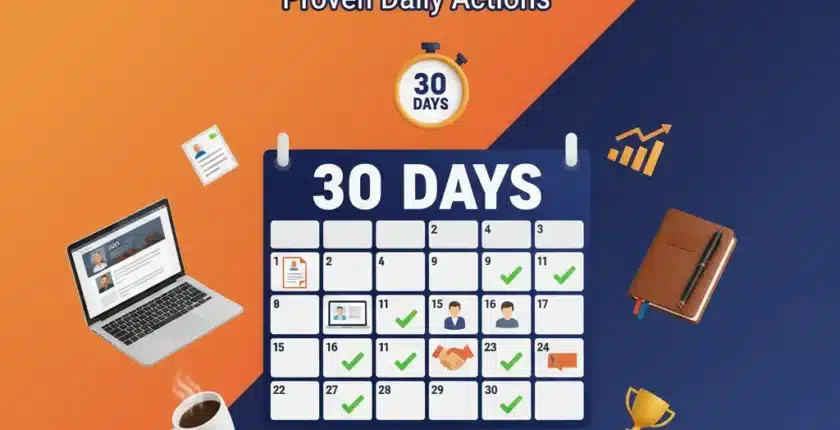
30 Day Job Search Plan: Land Interviews in One Month
Tom had been casually job searching for 6 months. He applied when he remembered. He updated his resume occasionally. He checked job boards sporadically. He never tracked anything.
After 6 months, he had 2 phone screens and zero final interviews. His unfocused approach produced minimal results.
When his company announced layoffs, casual searching became urgent. Tom needed a systematic approach.
He created a 30 day job search plan with daily actions, clear targets, and accountability systems. He worked his plan methodically for 4 weeks.
Results: 43 applications submitted. 12 phone screens completed. 7 final interviews scheduled. 3 job offers received. Tom accepted a senior analyst role with an 18 percent salary increase.
The difference was not luck. The difference was treating job searching like a job itself. Focused daily effort beats sporadic activity every time.
This guide provides your 30-day roadmap to land interviews fast. Daily action steps, realistic targets, and proven strategies that produce results in 4 weeks.

Table of Contents
How This Plan Works
This 30-day plan balances volume with quality, daily action with strategic thinking, and applying with networking.
Realistic Expectations
Thirty days is enough time to generate interviews. It is usually not enough time to receive and accept offers, though Tom’s experience shows it happens.
Realistic 30-day outcomes include 30 to 50 applications submitted, 8 to 15 phone screens or first interviews, 4 to 8 second or final interviews, and 1 to 3 job offers in progress or received.
Your mileage varies based on your field, experience level, market conditions, and execution quality.
The plan works if you work it. Skipping days or cutting corners reduces results.
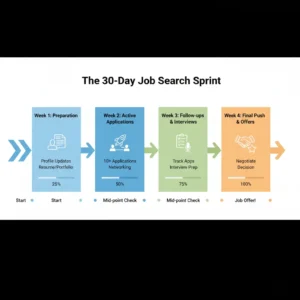
Here’s your complete 30-day roadmap:
Time Commitment
Dedicate 3 to 4 hours daily to job searching. Treat it like a part-time job.
If currently employed, dedicate 90 minutes in the morning and evening. Wake up 90 minutes earlier or work evenings. Weekend days allow longer sessions.
If unemployed, dedicate 4 to 6 hours daily. Structure your day with clear start and end times. Job searching all day without boundaries leads to burnout and decreased effectiveness.
Before You Start: Pre-Work Week
Complete these setup tasks before Day 1.
Clarify Your Target
Define what you want. Vague goals produce vague results.
Specify job titles you are targeting. List 3 to 5 variations. Example: Marketing Manager, Senior Marketing Manager, Marketing Lead, Growth Marketing Manager.
Identify industries or company types. Startups versus established companies. B2B versus B2C. Tech versus traditional industries.
Determine geographic preferences. Remote roles only. Specific cities. Regional flexibility.
Set salary requirements. Know your minimum acceptable offer. Know your target range.
Write this down. Your targets guide every decision in the next 30 days.
Prepare Your Materials
Update your resume following ATS optimization guidelines to pass screening software.
Write a master cover letter template. You will customize for specific applications, but a strong template saves time.
Optimize your LinkedIn profile completely. Professional photo, compelling headline, detailed summary, quantified achievements, relevant skills, and recommendations.
Use downtime to complete strategic career courses that strengthen your candidacy.
Create or update your portfolio if applicable. Have work samples ready to share.
Gather references. Contact 3 references and get their permission. Brief them on the roles you are pursuing.
Set Up Your System
Create a job application tracking spreadsheet.
Essential columns: Company, Position, Date Applied, Source, Contact, Status, Follow-up Date, Notes.
Set up accounts on LinkedIn, Indeed, Glassdoor, ZipRecruiter, and 2 industry-specific job boards.
Create job alerts for your target roles on all platforms. Set to daily notifications.
Research 30 target companies. Make a list of companies where you want to work. You will prioritize their openings.
Learn which job boards work best using our comprehensive job board strategies.
Prepare your workspace. Dedicated space for job searching. Eliminate distractions during work sessions.
Week 1: Foundation and Launch
Days 1 to 2: Profile Optimization
Day 1 Morning: Complete LinkedIn profile updates. Add missing sections. Update headline and summary. Add recent accomplishments.
Day 1 Afternoon: Request 3 recommendations on LinkedIn. Message former colleagues or managers with specific requests.
Day 2 Morning: Optimize Indeed and Glassdoor profiles. Upload resume. Complete all profile sections.
Day 2 Afternoon: Join 5 professional groups on LinkedIn related to your field. Engage with 3 posts in each group.
Days 3 to 4: Target Company Research
Day 3: Research 15 companies from your target list. Read recent news. Review LinkedIn company pages. Identify key people to connect with.
Day 4: Research 15 more target companies. Look for open positions at these companies. Add contacts to your networking list.
Days 5 to 7: First Applications
Day 5: Apply to 5 positions. Customize resume and cover letter for each. Track every application.
Day 6: Apply to 5 more positions. Prioritize newer postings less than 3 days old.
Day 7: Apply to 5 positions. Review and improve your application materials based on experience so far.
Week 1 Target: 15 applications submitted. LinkedIn profile optimized. 30 target companies researched.
Week 2: Momentum Building
Days 8 to 10: Scale Applications
Day 8: Apply to 6 positions. Focus on roles posted in the last 48 hours.
Day 9: Apply to 6 positions. Vary your sources across different job boards.
Day 10: Apply to 6 positions. Include at least 2 applications directly on company websites.
Days 11 to 12: Networking Push
Day 11: Engage actively on LinkedIn. Comment on 10 posts. Share 1 relevant article with your insights. Message 3 connections asking about their companies.
Day 12: Use networking strategies designed for introverts if large events feel overwhelming.
Days 13 to 14: Follow-Up System
Day 13: Follow up on applications from week 1. Send brief follow-up emails to hiring managers when possible.
Day 14: Review week 2 progress. Adjust strategies based on what is working. Continue applications. Target 5 to 6 today.
Week 2 Target: 18 additional applications (33 total). 10 new connections. Follow-ups sent on week 1 applications.
Week 3: Interview Preparation
Days 15 to 17: Practice Interviews
Day 15: List 20 common interview questions for your field. Write STAR method answers for each.
Day 16: Practice answering questions out loud. Record yourself. Note areas needing improvement.
Day 17: Prepare questions to ask interviewers. Research company-specific questions for each place where you applied.
Days 18 to 19: Company Deep Dives
Day 18: Deep research on 5 companies where you have interviews or a strong interest. Study their products, recent news, competitors, and challenges.
Day 19: Research your interviewers on LinkedIn. Find common ground. Prepare personalized talking points.
Days 20 to 21: Continued Applications
Day 20: Apply to 5 positions. Quality remains high. Do not rush applications.
Day 21: Apply to 5 positions. Follow up on week 2 applications.
Week 3 Target: 10 additional applications (43 total). Interview preparation complete. 2 to 4 interviews scheduled or completed.
Week 4: Final Push
Days 22 to 24: Quality Applications
Day 22: Apply to 4 highly targeted positions. Spend extra time on customization.
Day 23: Apply to 4 positions at companies in your top 10 list.
Day 24: Apply to 4 positions. Focus on roles where you exceed requirements.
Days 25 to 27: Maximize Networking
Day 25: Request 3 informational interviews with people in your target roles or companies.
Day 26: Attend 1 virtual or in-person networking event. Follow up with everyone you meet.
Day 27: Send thank-you notes to everyone who has helped you during the 30 days. Maintain relationships.
Days 28 to 30: Review and Adjust
Day 28: Analyze results. Calculate the application-to-interview ratio. Identify which approaches worked best.
Day 29: Follow up on all outstanding applications. Send status inquiry emails where appropriate.
Day 30: Create week 5 plan. Continue what worked. Eliminate what did not. Maintain momentum.
Week 4 Target: 12 additional applications (55 total). 3 informational interviews. Analysis and planning complete.
Daily Job Search Routine
Structure each day for maximum productivity.
Follow this daily structure for consistent progress:
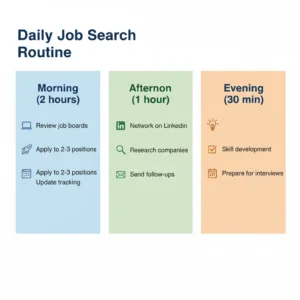
Morning Block: 2 Hours
8:00 to 8:30: Review new job alerts. Identify 2 to 3 positions to apply for today.
8:30 to 9:30: Research companies and customize application materials for the first position.
9:30 to 10:00: Submit first application. Track in a spreadsheet. Research second position.
Afternoon Block: 1 Hour
2:00 to 2:30: Submit second application. Follow up on previous applications if applicable.
2:30 to 3:00: LinkedIn engagement. Network outreach. Company research for tomorrow.
Evening Block: 30 to 60 Minutes
6:00 to 6:30: Third application if energy permits. Otherwise, prepare materials for tomorrow.
6:30 to 7:00: Interview preparation if you have upcoming interviews. Skills development, if time permits.
This routine creates consistency. You make progress daily without burning out.
Adjust timing to fit your schedule. Keep the structure.
Tracking Your Progress
Your tracking spreadsheet is your command center.
Update immediately after every action. Applied to a job. Add to the spreadsheet before moving on.
Review your spreadsheet daily. You see progress accumulating. You spot patterns.
Calculate key metrics weekly. Use appropriate tools, Calendly, Trello, Google Calendar.
Monitor these key performance indicators weekly:
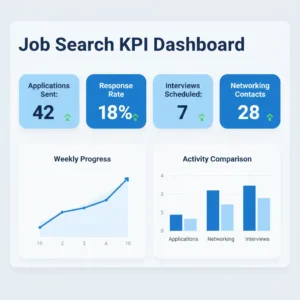
Application to response rate: Responses divided by applications. Target 12 to 18 percent.
Response to interview rate: Interviews divided by responses. Target 60 to 75 percent.
Average time to response: How many days from application to hearing back? Faster means you are applying to newer postings.
If metrics fall below targets, adjust your approach. Better targeting. More customization. Faster application timing.
What to Do If You Are Not Getting Results
If week 2 ends with fewer than 2 responses, make changes immediately.
Review your resume with ATS checking tools . Ensure it parses correctly and includes relevant keywords.
Increase application customization. Spend 30 to 45 minutes per application instead of 15 to 20.
Apply faster after postings appear. Target applications within 24 hours of the job posting.
Expand your search criteria. You might be too narrow in targeting.
Get feedback. Ask a mentor, colleague, or professional resume reviewer to evaluate your materials.
Increase networking efforts. Apply less. Network more. Referrals generate better response rates.
Do not keep doing the same things expecting different results. Data tells you what to change.
Success Stories and Timelines
Real outcomes from this 30-day approach.
Sarah, Marketing Manager: 38 applications, 9 phone screens, 4 final interviews, 2 offers. Accepted offer Day 32.
David, Software Engineer: 52 applications, 14 phone screens, 6 final interviews, 3 offers. Accepted offer on Day 28.
Jennifer, Project Manager: 41 applications, 7 phone screens, 5 final interviews, 1 offer. Accepted offer Day 45.
Michael, Sales Representative: 47 applications, 11 phone screens, 8 final interviews, 2 offers. Accepted offer Day 37.
Your timeline depends on your field, seniority, market conditions, and location. Some fields move faster than others.
The plan generates momentum. Momentum creates opportunities. Opportunities become offers.
Frequently Asked Questions (FAQs)
Q: What if I am currently employed?
Adjust daily time commitment. Dedicate 90 minutes morning and evening. Use lunch breaks for LinkedIn engagement. This compressed schedule still works.
Q: Should I tell my current employer I am job searching?
No, unless you have an excellent relationship and they can help. Job searches fail sometimes. Protect your current position.
Q: How do I handle multiple interviews at different companies?
Schedule strategically. Be honest about your timeline with recruiters. You are interviewing with multiple companies. They expect this.
Q: What if I do not get any offers in 30 days?
This happens. Continue the plan into weeks 5, 6, and beyond. Your applications from weeks 3 and 4 often generate interviews in weeks 5 and 6. Momentum builds.
Q: Should I accept the first offer I receive?
Only if it meets your requirements. If the offer is acceptable, you have no other final interviews scheduled, and waiting risks losing it, accept. If you have better prospects in the final stages, negotiate timing or politely decline.
Q: Can I modify this plan?
Yes. Adjust to your situation. The principles remain: daily action, systematic tracking, balanced applying and networking, and continuous improvement.
Your 30-day job search plan gives you structure and accountability. Motivation fades. Systems sustain effort.
Print this plan. Check off each day as you complete it. The visual progress motivates continued effort.
Thirty days from now, you will have generated multiple interviews. Some will turn into offers. Your focused effort will pay off.
Start tomorrow morning. Not Monday. Not after you feel ready. Tomorrow.
Your next career move begins with Day 1.
For more job search strategies, explore our resume optimization guide, LinkedIn profile tips, networking strategies, and complete career transition resources.