

How to Use a Carbon Footprint Calculator | General Steps Guide
You want to measure your carbon footprint. You found a calculator online. Now you need to know how to use it correctly.
This guide shows you exactly how to input data, interpret results, and take action based on your numbers.
Before You Start
Gather these documents before you begin:
Your electricity and gas bills from the past 12 months
Your car mileage records or estimation
Your flight history from the past year
Your typical grocery shopping receipts
This preparation takes 5 minutes. You will get more accurate results.
Before using the tool:
Learn about carbon footprint calculators.
How to use the carbon footprint calculator.

Table of content
Step 1: Choose Your Calculator
Visit the OpinoHive Carbon Footprint Calculator. This tool utilizes EPA-approved emissions factors and provides personalized recommendations.
Look for calculators that show:
Data sources and methodology
Transparent emissions factors
Personalized action suggestions
Easy-to-understand results
Step 2: Enter Your Home Energy Data
The calculator first asks about your home energy use.
Home size: Enter your square footage. Larger homes typically use more energy.
Heating and cooling: Select your system type. Natural gas, electric heat pump, oil furnace, or propane. Each has different emission levels.
Monthly electricity use: Check your bills. Enter kilowatt hours or dollar amount. The calculator converts dollars to emissions using average rates.
Monthly gas use: Enter therms or cubic meters from your bill.
If you do not have exact numbers, estimate. The calculator provides average ranges based on home size and location. Discover strategies to cut your home energy emissions by 70 percent.
Step 3: Input Transportation Information
Transportation often creates your largest emissions.
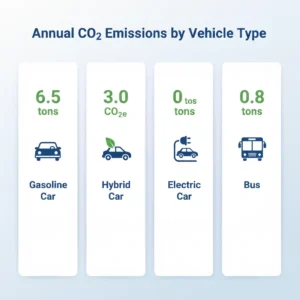
Vehicle type: Select gas, diesel, hybrid, plug-in hybrid, or electric. Each produces different emissions per mile.
Annual mileage: Check your odometer. Subtract last year’s reading from the current reading. Or estimate based on weekly driving.
Fuel efficiency: Enter miles per gallon if you know it. Otherwise, select your vehicle make and model.
Public transportation: Enter weekly trips by bus, train, or subway.
Flights: Count your flights in the past year. Separate short haul (under 3 hours), medium haul (3 to 6 hours), and long haul (over 6 hours). Flight emissions vary significantly by distance.
Learn how to reduce your transportation emissions effectively.
Step 4: Document Your Diet
Food production creates substantial emissions.
Meat consumption: Select how many days per week you eat red meat, poultry, and fish. Beef produces 27 kg CO₂e per kilogram. Chicken produces 6 kg CO₂e per kilogram.
Dairy intake: Enter your weekly consumption of milk, cheese, and yogurt. Dairy produces 2 to 8 kg CO₂e per kilogram, depending on the product.
Plant-based foods: Indicate the percentage of meals that are vegetarian or vegan. Plant proteins produce 0.4 to 2 kg CO₂e per kilogram.
Food waste: Estimate what percentage of food you throw away. Food waste in landfills produces methane.
Local vs imported: Select how often you buy local seasonal produce versus imported foods. Transportation adds emissions.
Step 5: Track Your Consumption
Manufacturing and shipping consumer goods create hidden emissions.
Clothing purchases: Enter approximate annual spending. Fast fashion has high emissions per item.
Electronics: Count the new devices purchased this year. Smartphones, laptops, tablets, and televisions require energy-intensive manufacturing.
Furniture and home goods: Estimate yearly spending on furniture, appliances, and home items.
Recycling habits: Select your recycling rate. Recycling reduces emissions from manufacturing new products.
Find practical ways to lower your food footprint.
Step 6: Review Your Results
The calculator shows your total annual footprint in tons of CO₂e.
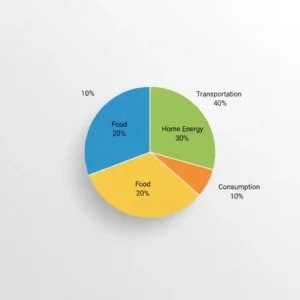
You see a breakdown by category:
Home energy percentage
Transportation percentage
Food percentage
Consumption percentage
Compare your number to benchmarks:
US average: 15 to 16 tons per person
Global average: 4 tons per person
Sustainable target: 2 to 3 tons per person
Step 7: Interpret Your Breakdown
Look at your pie chart or bar graph. Your largest category is your biggest opportunity.
If transportation dominates (over 40 percent):
Reduce driving by combining trips
Use public transit twice per week
Avoid one flight per year
Consider an electric or hybrid vehicle
If home energy dominates (over 35 percent):
Switch to LED bulbs throughout your home
Lower the thermostat by 2 degrees in winter
Raise the thermostat 2 degrees in summer
Add insulation to the attic and walls
Choose renewable energy from your utility
If food dominates (over 25 percent):
Reduce red meat to once per week
Increase plant-based meals to 3 days per week
Buy local produce when available
Reduce food waste by meal planning
If consumption dominates (over 20 percent):
Buy fewer new items overall
Choose secondhand for clothing and furniture
Repair items instead of replacing them.
Invest in quality over quantity
Step 8: Select Your First Action
The calculator provides personalized recommendations ranked by impact.
Choose one action you will start this month. Do not try to change everything at once.
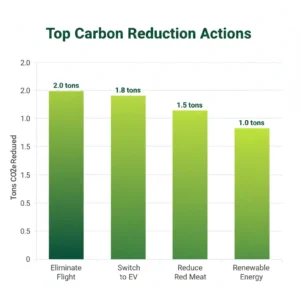
High-impact actions (save 1+ tons per year):
Eliminate one round-trip flight
Reduce red meat to once weekly
Switch to an electric vehicle
Install solar panels
Choose a renewable energy plan
Medium-impact actions (save 0.3 to 1 ton per year):
Take public transit twice weekly
Reduce dairy consumption by half
Install a programmable thermostat
Buy secondhand clothing exclusively
Low-impact actions (save under 0.3 tons per year):
Switch to LED bulbs
Unplug devices when not in use
Recycle consistently
Use reusable shopping bags
Start with high-impact changes. These create the biggest reduction in your effort.
Step 9: Create Your Reduction Plan
Set a reduction goal. Aim to cut your footprint by 10 to 20 percent in your first year.
Make a timeline:
Month 1: Implement one high-impact change
Month 3: Add one medium-impact change
Month 6: Recalculate your footprint
Month 12: Assess progress toward goal
Track your actions in a spreadsheet or notebook. Write down what you changed and when.
Review proven reduction strategies for maximum impact.
Also track changes throughout the year to understand seasonal variations.
Step 10: Recalculate Regularly
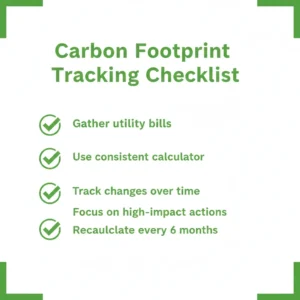
Return to the calculator every 6 months. Enter your updated information.
Watch your number decrease. This motivates continued action.
Compare seasonal differences. Your winter heating and summer cooling affect results.
Adjust your plan based on what works. If driving reduction is hard, focus on food changes instead.
Common Mistakes to Avoid
Guessing wildly: Rough estimates are fine, but wild guesses skew results. Spend 5 minutes finding real numbers.
Ignoring hidden emissions: Manufacturing, shipping, and disposal add emissions beyond direct use.
Compared to others: Your footprint reflects your specific circumstances. Location, climate, and infrastructure affect results.
Feeling overwhelmed: Start with one change. Progress beats perfection.
Buying offsets instead of reducing: Reduce first. Offset only unavoidable emissions.
Using multiple calculators: Different methodologies give different numbers. Pick one calculator and track changes over time with the same tool.
Learn about carbon offsetting as a supplement, not a replacement.
Advanced Calculator Features
Some calculators offer advanced options:
Regional customization: Electricity emissions vary by location. Coal-heavy grids produce more than renewable heavy grids.
Scenario modeling: Test “what if” questions. “What if I switched to an EV? “See the impact before you invest.
Household vs. individual: Calculate for your whole household or just yourself.
Export results: Download your data for record keeping.
Why Your Numbers Matter
Your footprint data helps you:
Make informed decisions about purchases
Prioritize reduction efforts effectively
Track progress over time
Advocate for systemic changes from knowledge
Educate others about climate impact
Frequently Asked Questions (FAQ’s)
Q: What is a carbon footprint?
A carbon footprint is the total amount of greenhouse gases emitted directly and indirectly by your activities over a specific period, usually a year. It includes CO2 from burning fuel, emissions from the electricity you use, and hidden emissions embedded in everything you consume, from food to clothing to electronics.
Q: Why should I calculate my carbon footprint?
Calculating your carbon footprint replaces vague guilt with concrete numbers. It shows you exactly which parts of your life produce the most emissions, so you stop guessing and start making changes that actually matter. Without knowing your number, your efforts to reduce emissions are essentially misdirected.
Q: How accurate is the Opinohive Carbon Footprint Calculator?
The Opinohive Carbon Footprint Calculator uses science-backed emissions factors from trusted sources to estimate your CO2 output. It is designed for clarity and everyday use, not scientific research, so results are reliable estimates based on your inputs rather than exact measurements.
Q: What does the calculator measure?
The calculator measures emissions across three main areas. Energy covers your monthly electricity usage in kWh and natural gas usage in therms. Transport covers your annual car mileage and the number of short and long flights per year. Lifestyle covers your dietary preferences and whether you recycle regularly.
Q: How long does it take to calculate my carbon footprint?
It takes under 2 minutes. The tool asks straightforward questions across energy, transport, and lifestyle. No jargon. No lengthy forms. You get your result the moment you click Calculate My Footprint.
Q: What is the average carbon footprint per person?
The average US carbon footprint is around 15 to 16 tons of CO2 equivalent per person per year. The global sustainable target is closer to 2 to 3 tons per person per year. Knowing where you stand against these numbers helps you set realistic reduction goals.
Q: Should I buy carbon offsets to reduce my footprint?
Carbon offsets should be a last resort, not a first step. The primary goal is always to reduce emissions at source. Offsets are useful only for truly unavoidable emissions after you have already made all the reductions you can. Relying on offsets without reducing first does not address the underlying problem.
Q: What should I do after I calculate my footprint?
Look at which category, energy, transport, or lifestyle, produces the most emissions in your result. Pick one achievable action in that category and focus on it for the next month. Recalculate in 6 months to track your progress. Seeing your number drop over time is one of the most effective motivators for continued action.
Q: Is the Opinohive Carbon Footprint Calculator free to use?
Yes. The tool is completely free. It runs entirely in your browser with no signup, no download, and no personal data collection required.
Q: Can I use the calculator more than once?
Yes. You can return to the calculator at any time to update your inputs and recalculate. Using it periodically lets you track whether your footprint is going up or down as your habits change.
Take Action Now
Visit the OpinoHive Carbon Footprint Calculator guide. Set aside 15 minutes. Input your data carefully.
Get your baseline number. Choose your first action. Start reducing your impact today.
Your footprint is your starting point. Measurement leads to management. Management leads to reduction.
Your future self will thank you.